
1. Advanced Drive Systems for Horizontal Feed Mixers
Horizontal Total Mixed Ration (TMR) mixers utilize multiple longitudinal augers equipped with serrated knives to chop, lift, and blend roughage, grains, and supplements. Unlike vertical mixers where the load rests firmly on a base thrust bearing, horizontal auger drives confront a distinctly different mechanical challenge. They must endure massive radial loads, severe bending moments, and continuous torsion along the entire length of the mixing tub. The drive unit must flawlessly transmit immense rotational force while physically suspending and supporting the heavy steel auger shaft.
To conquer these severe dynamic forces, heavy-duty epicyclic gear reducers have become the industry standard. Their compact, coaxial design allows them to be flange-mounted directly to the front or rear structural plates of the mixer tub. By distributing the extreme cutting forces across multiple internal gear sets simultaneously, these transmission units prevent the catastrophic shaft shearing and gear tooth fracturing that frequently destroy conventional parallel-shaft gearboxes in agricultural settings.
.webp)
A robust flange-mounted transmission unit designed specifically for the rigorous demands of horizontal agricultural mixers.
2. Standard Technical Specifications
Our agricultural drive units are engineered with strict metallurgical controls and precision machining tolerances to guarantee maximum operational uptime. The parameters below outline the capabilities of our standard horizontal auger drive series.
| Specification Parameter | Performance Range / Details |
|---|---|
| Continuous Output Torque | 12,000 Nm – 95,000 Nm |
| Standard Reduction Ratios | 15:1 to 65:1 (Optimized for horizontal chopping speeds) |
| Nominal Input Speed | 540 RPM / 1000 RPM (Tractor PTO standard) |
| Max Radial Load Capacity | Up to 300,000 N (Extended tapered roller bearings) |
| Input Spline Configurations | 1-3/8″ 6-spline, 1-3/8″ 21-spline, 1-3/4″ 20-spline |
| Output Shaft Design | Splined male shaft or heavy-duty flanged hub mount |
| Gear Metallurgy | 20CrMnTi Forged Alloy, Deep Case Carburized (HRC 58-62) |
| Environmental Sealing | IP65 rated, multi-lip Viton cassette seals to block acidic feed juices |
| Lubrication Requirements | ISO VG 150 / 220 Extreme Pressure (EP) Synthetic Gear Oil |
3. Kinematic Engineering and Force Distribution
The mechanical kinematics inside a horizontal TMR mixer gearbox are explicitly engineered to maximize torque output while neutralizing destructive external forces. Power from the tractor is channeled through the PTO driveline into the primary input shaft. In single-auger horizontal mixers, this connects directly to the reduction unit. In multi-auger configurations (such as three-auger or four-auger machines), a robust roller chain system or an intermediary spur gear drop-box splits the primary power, routing it securely to individual planetary gearboxes mounted onto the end of each respective auger shaft.
Once rotational energy enters the reduction housing, the high-speed input drives the central sun gear. This sun gear engages simultaneously with multiple planet gears housed within a heavy-duty carrier assembly. As the planet gears revolve inside a stationary, internally toothed ring gear, they force the carrier to rotate at a drastically reduced velocity. This epicyclic reduction flawlessly converts the standard 540 RPM input into a massive, low-speed rotational force (typically ranging between 15 to 35 RPM). This extreme torque multiplication is absolutely vital for slicing through heavily compacted round bales and thick molasses mixtures without stalling the tractor engine.
The defining mechanical feature of our horizontal drive series is its advanced output bearing architecture. A horizontal auger acts essentially as a giant cantilevered beam inside the tub. When dense feed pushes upward and laterally against the auger flights during blending, it creates intense radial leverage that attempts to snap the gearbox output shaft. We neutralize this threat by spacing massive, high-capacity tapered roller bearings far apart within an extended cast-iron output housing. This wide bearing span absorbs the extreme bending moments, isolating the sensitive internal planetary gears from structural deflection and ensuring perfect gear mesh alignment under peak payloads.
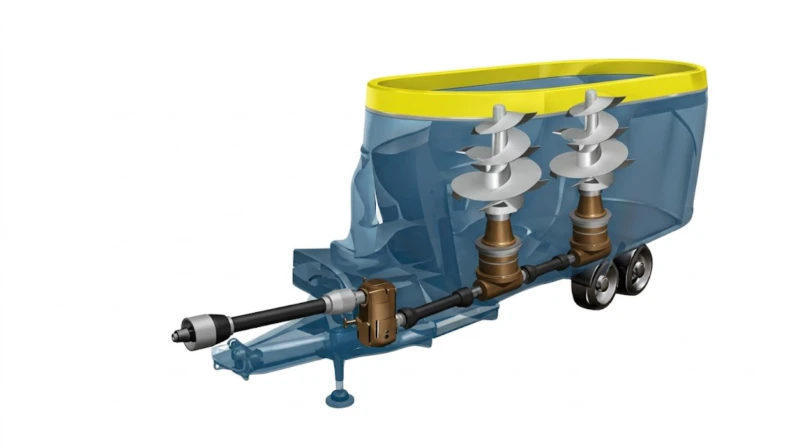
Kinematic diagram illustrating torque flow and reduction stages.
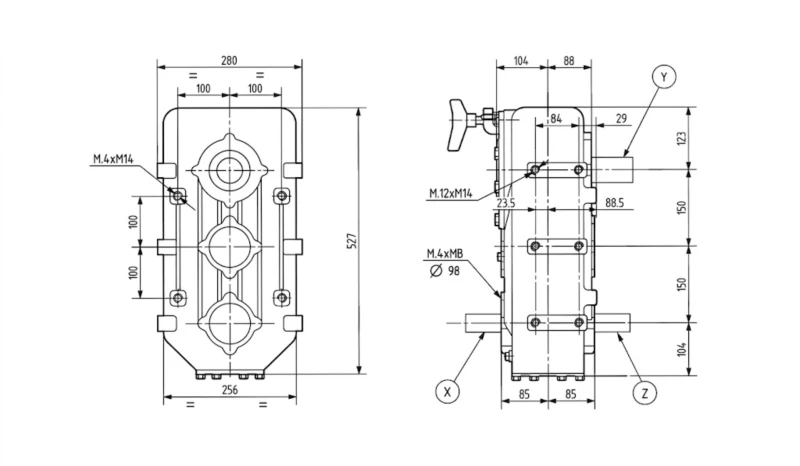
Cross-section revealing the extended output bearing span.
4. Global Application Scenarios in Agriculture
Agricultural feeding operations cannot pause for machinery failure. Equipment downtime translates immediately into disrupted nutrition schedules and lost milk production yields. Our transmission components are trusted by premier mixer manufacturers worldwide to deliver uninterrupted performance.
France: High-Moisture Silage Handling (Normandy)
In the dense dairy region of Normandy, France, a cooperative utilizing massive four-auger horizontal mixers faced chronic drivetrain failures. The high moisture content and acidic nature of the local grass silage created immense drag and accelerated seal degradation. Competitor gearboxes were suffering from saltwater-like corrosion and frequent output shaft shearing. We upgraded their machinery with our severe-duty series featuring triple-lip Viton seals and marine-grade epoxy housing coatings. Over an intensive two-year monitoring period, the French cooperative recorded zero seal leaks and completely eliminated shaft shear events, handling the dense wet rations flawlessly.
United States: Frozen Bale Processing (Wisconsin)
A large-scale commercial dairy in Wisconsin routinely processes fully frozen alfalfa round bales during extreme winter months. Dropping these solid ice-bound bales into a horizontal mixer generates brutal kinetic shockwaves through the driveline. The farm’s original parallel-shaft gearboxes experienced severe gear tooth pitting and bearing collapse. By retrofitting the fleet with our multi-stage planetary drives—which distribute the kinetic shock across multiple sun and planet gears—the dairy dramatically improved its winter reliability. The robust epicyclic design absorbed the brutal impact loads, allowing the tractor to maintain consistent RPMs without driveline failure.
Australia: High-Abrasive Dust Environments (Victoria)
A prominent sheep station in Victoria operated trailed horizontal mixers across vast, unpaved terrain. The highly abrasive airborne silica dust generated during dry season feeding was penetrating the standard breather valves and input seals of their previous gearboxes, contaminating the gear oil and destroying internal bearings. We supplied a fleet retrofit using our agriculturally sealed drives equipped with closed-loop expansion chambers and protective labyrinth shielding. This advanced sealing technology completely blocked particulate ingress. Maintenance logs confirmed perfectly clean oil samples at the scheduled 1,000-hour service intervals, solving the abrasive wear crisis.
5. Universal Dimensional Compatibility
Agricultural machinery manufacturers globally base their chassis designs on established European dimensional profiles. Recognizing the critical need for rapid aftermarket support and supply chain agility, our horizontal reduction units are machined to match universal mounting flanges, output splines, and overall axial footprints.
Equipment engineers and procurement managers can confidently specify our units as direct drop-in replacements for major European brands without costly modifications to the mixer tub’s structural plates or the primary auger shafts.
| Mixer Application Category | Our Replacement Series | Compatible Industry Footprints |
|---|---|---|
| Light-Duty Horizontal (1-2 Augers) | HFM-100 Series | Comer PG / Brevini ED Base Models |
| Medium-Duty Horizontal (3 Augers) | HFM-200 Series | Comer PGA / Bonfiglioli 300 Series equivalents |
| Heavy-Duty Commercial (4 Augers) | HFM-300 Series | Reggiana Riduttori RR / High-torque industrial footprints |
6. Driveline Protection: Agricultural PTO Shafts
Even the most robust planetary reducer requires protection from catastrophic mechanical overloads. When foreign objects like heavy stones, metal debris, or exceptionally dense frozen blocks enter the mixing tub, the horizontal augers can jam instantly. If the tractor’s Power Take-Off (PTO) continues to force rotational power into a jammed machine, the extreme kinetic buildup will aggressively destroy the weakest point in the driveline. To mitigate this severe risk, the gearbox must be paired with a properly calibrated agricultural PTO shaft featuring an integrated safety mechanism.
We provide heavy-duty PTO drive shafts equipped specifically with shear bolt clutches or adjustable friction slip clutches. A shear bolt clutch utilizes a specifically graded metallic bolt designed to snap cleanly under excessive torque, instantly severing the power connection to the mixer. Conversely, a friction clutch allows internal steel plates to slip against each other when the load exceeds a preset limit, absorbing the kinetic shock without requiring physical component replacement in the field.
Matching the precise clutch torque rating to the input capacity of the reduction unit is highly critical for machine longevity. When you buy Planetary Gearbox assemblies for your manufacturing pipeline or fleet upgrades, integrating our perfectly matched driveline safety systems ensures the entire powertrain remains structurally sound over years of abusive agricultural use.
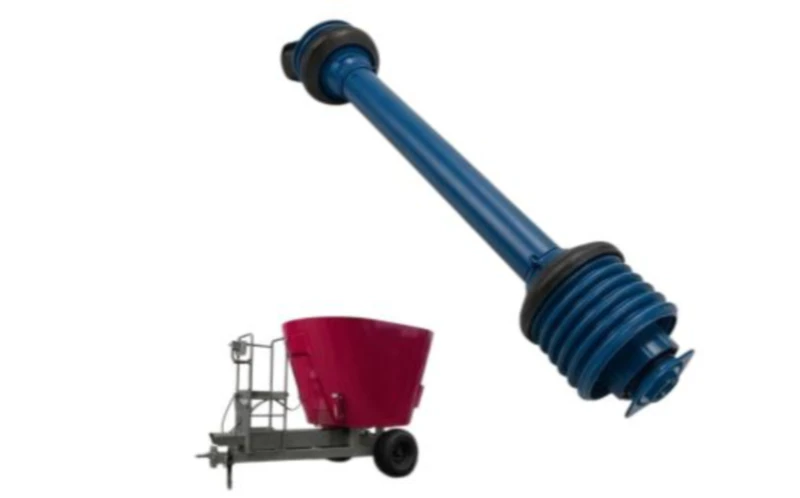
A matched PTO driveline with a safety clutch is essential to protect the internal planetary gears from sudden auger jams.
7. Practical Operation and Maintenance FAQ
1. What is the recommended break-in oil change interval for a horizontal mixer gearbox?
The critical initial oil change must be performed after the first 50 to 100 operating hours to flush out normal micro-metallic particles generated during gear seating. Subsequent standard oil changes should occur every 500 to 800 hours.
2. Why is radial load capacity so important for horizontal mixers compared to vertical ones?
Horizontal augers are mounted sideways and push heavy feed laterally, creating massive bending leverage (radial load) on the output shaft. Vertical augers primarily push weight straight down (axial load). Our horizontal drives feature specifically widened bearing spans to handle this bending force.
3. What type of lubrication is required for maximum gear protection?
We mandate the use of high-quality Extreme Pressure (EP) gear lubricant. An ISO VG 150 or API GL-5 85W-140 synthetic gear oil provides the necessary film thickness to protect the meshing gear teeth under extreme agricultural shock loads.
4. Can the gearbox input splines be customized to fit older tractor models?
Yes. While 1-3/8″ 6-spline and 21-spline are the standard configurations, our engineering department can machine custom input shafts to accommodate legacy machinery or specific heavy-duty PTO driveline yokes.
5. How do you prevent acidic silage juices from destroying the internal bearings?
We utilize advanced multi-lip Viton cassette seals on the output shaft. These industrial-grade seals create an impenetrable barrier against corrosive moisture, highly acidic silage runoff, and abrasive dirt.
6. What causes a planetary gearbox to overheat during routine feed mixing?
Overheating is typically caused by three factors: significantly overfilling the gear oil (causing fluid churning), consistently processing loads that exceed the machine’s rated cubic capacity, or running the PTO at speeds far higher than the implement design limits.
7. Are your reduction units suitable for stationary electric feed mills?
Absolutely. While widely deployed on tractor-pulled mobile mixers, our gearboxes are easily adapted for stationary facility use by coupling a high-torque AC electric motor to the input shaft via a heavy-duty belt drive or direct flexible coupling.
8. If the gearbox makes a sudden grinding noise, what is the immediate protocol?
Disengage the PTO immediately. Drain a small amount of oil to inspect for metal shavings. A grinding sound strongly indicates a collapsed internal bearing or a fractured gear tooth resulting from foreign object ingestion; operating further will destroy the housing.
9. What is the standard lead time for ordering replacement fleet components?
Standard configurations that align with universal European dimensions are typically processed and ready for dispatch within 2 to 4 weeks. High-volume orders or custom ratio machining may require 6 to 8 weeks of lead time.
10. How can machinery manufacturers arrange for custom OEM prototypes?
For technical engineering support, ratio modifications, or to order a custom Planetary Gearbox prototype for your upcoming mixer line, please reach out directly to our global sales and technical engineering team.