
1. Maritime Power Transmission Systems
Global logistics rely on the uninterrupted operation of port and terminal facilities. The heavy lifting equipment utilized in these hubs—ranging from massive Ship-to-Shore container cranes to agile automated stacking cranes—requires power transmission components capable of functioning flawlessly under severe dynamic loads and highly corrosive atmospheric conditions. The mechanical drives responsible for hoisting containers, slewing the crane superstructure, and traveling along the rails must deliver absolute reliability to prevent costly vessel delays.
The epicyclic reduction architecture is the mechanical standard for modern maritime lifting equipment. By utilizing a compact, coaxial design, these heavy-duty reducers provide unmatched torque density. This allows port crane manufacturers to install immensely powerful hoisting and slewing drives within the physically constrained machinery houses of the crane. Constructed from premium forged alloy steels and protected by advanced marine-grade surface treatments, our transmission systems are built to endure the aggressive saltwater spray, high humidity, and extreme shock loads inherent to 24/7 port operations.
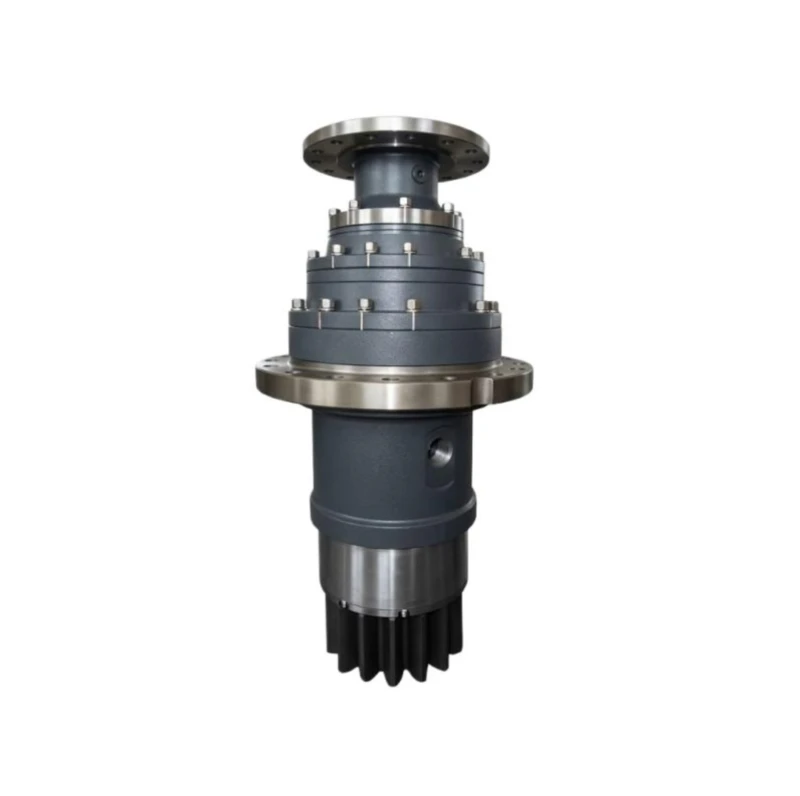
Heavy-Duty Slewing Drive unit designed specifically for the rotational mechanisms of maritime harbor cranes.
2. Standard Technical Specifications
Our maritime transmission units are manufactured in strict accordance with international offshore and harbor equipment standards. The parameters detailed below outline the performance boundaries of our primary hoist, slew, and travel series.
| Specification Parameter | Performance Range / Engineering Details |
|---|---|
| Maximum Output Torque Capacity | 25,000 Nm to over 1,200,000 Nm |
| Standard Gear Reduction Ratios | 20:1 up to 1500:1 (Multi-stage configurations) |
| Corrosion Protection Standard | C5-M Marine Grade Epoxy System (ISO 12944) |
| Integrated Braking System | Spring-Applied, Hydraulically-Released (SAHR) Fail-Safe Multi-Disc |
| Environmental Sealing Rating | IP67 / IP68 (Labyrinth and mechanical face seals) |
| Main Output Bearings | Oversized heavy-duty tapered roller and spherical roller bearings |
| Gear Metallurgy | 18CrNiMo7-6 Forged Alloy, Case Carburized & Precision Ground |
| Torsional Backlash | ≤ 5 arcminutes (Ensuring rigid boom and turntable control) |
| Ambient Operating Temperature | -30°C to +60°C (Climate-specific synthetic lubricants required) |
3. Kinematic Engineering and Force Distribution
The immense lifting capabilities of a port crane depend entirely on the mechanical advantage generated within the reduction housing. High-speed input from massive electric variable-frequency drive (VFD) motors or hydraulic power units enters the central sun gear of the transmission. This sun gear simultaneously drives multiple intermediate planet gears, which are firmly mounted on a rotating carrier assembly. As these planet gears rotate, they walk along the internal teeth of a heavy, stationary outer ring gear, forcing the carrier to rotate at a highly reduced speed but with exponentially multiplied torque.
This specific epicyclic layout provides a critical structural advantage over traditional parallel-shaft gearboxes: load distribution. When an STS crane hoists a fully loaded 40-foot shipping container, or when a sudden wind gust strikes a suspended load, violent kinetic shockwaves travel through the wire ropes directly into the hoist drum. Because the planetary design divides this shock load equally across three or four mesh points, it effectively eliminates the risk of catastrophic single-tooth shear, ensuring the load remains safely suspended under severe stress.
For slewing operations (rotating the crane superstructure), the mechanics require distinct output architecture. The output shaft of the slewing gearbox is typically an extended, integral pinion gear. This pinion meshes directly with the massive slewing ring bearing bolted to the crane pedestal. These specific units are equipped with vastly oversized radial bearings to absorb the extreme bending moments generated when accelerating and decelerating the heavy, overhanging jib and suspended cargo.
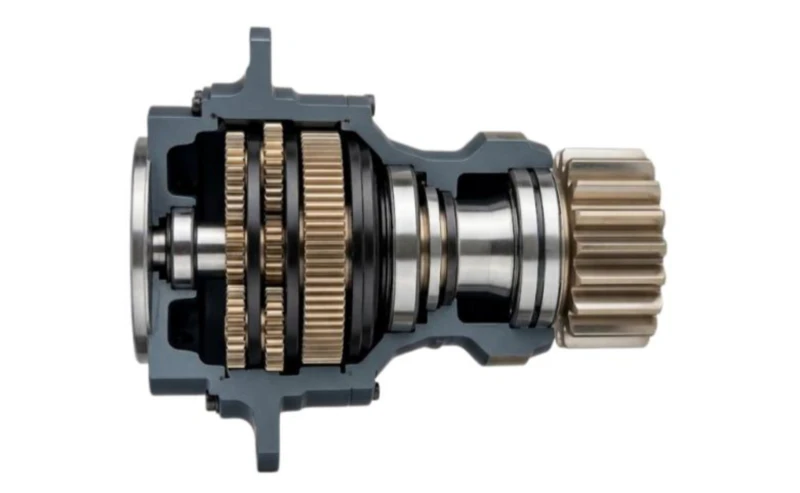
Cross-sectional view revealing the extended output pinion and heavy-duty bearing arrangement.
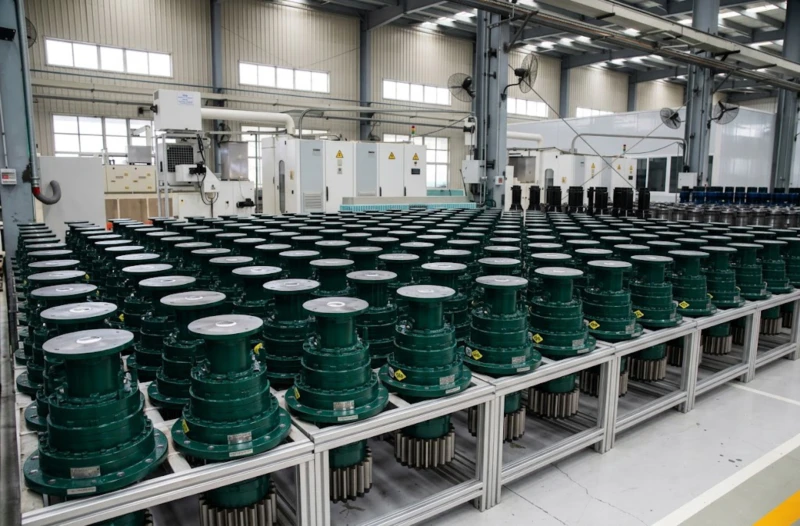
Fully assembled slewing unit, ready for flange mounting onto the crane deck.
4. Global Application Scenarios in Maritime Logistics
Minimizing unscheduled downtime is the primary metric for port operators. Equipment failure during a vessel turnaround incurs massive penalties and disrupts entire supply chains. Our mechanical drive systems are trusted by leading port authorities globally to maintain absolute operational continuity.
France: Upgrading STS Cranes at the Port of Marseille Fos
The Port of Marseille Fos, handling massive volumes of Mediterranean container traffic, required comprehensive overhauls for several aging Ship-to-Shore cranes. The existing hoist drives were suffering from accelerated corrosion due to constant exposure to high-salinity coastal winds and sea spray. We supplied upgraded main hoist reducers engineered with strict C5-M marine-grade epoxy coatings and advanced labyrinth breathers that blocked airborne salt intrusion. Over an intensive 36-month tracking period post-installation, the port authority reported a total elimination of saltwater contamination within the gear oil, significantly extending the mean time between failures (MTBF) and lowering maintenance overhead.
Singapore: Automated RTG Fleets at Tuas Megaport
As Singapore expands its next-generation Tuas Megaport, reliance on fully automated Rubber-Tired Gantry (RTG) and Automated Stacking Cranes (ASC) is absolute. These autonomous cranes operate 24/7 without human intervention, requiring travel and hoist drives with exceptional precision. We outfitted a fleet of these automated cranes with our low-backlash travel drive series. The precision-ground planetary gears eliminated starting and stopping shudder, allowing the crane’s optical positioning systems to place containers onto automated guided vehicles with millimeter accuracy, directly contributing to the port’s target handling rates.
United States: Mobile Harbor Cranes in the Port of Long Beach
A major stevedoring contractor at the Port of Long Beach utilizes heavily loaded Mobile Harbor Cranes (MHC) to handle both bulk materials and oversized breakbulk cargo. Operating under the intense Southern California sun, continuous heavy-lift cycles were causing conventional slewing gearboxes to overheat, resulting in premature bearing failure. We provided a solution by retrofitting the cranes with our heavy-duty slewing reducers featuring enhanced oil sump capacities and integrated thermal dissipation fins. The upgraded thermal management stabilized operating temperatures, ensuring uninterrupted bulk discharge operations during peak summer shipping seasons.
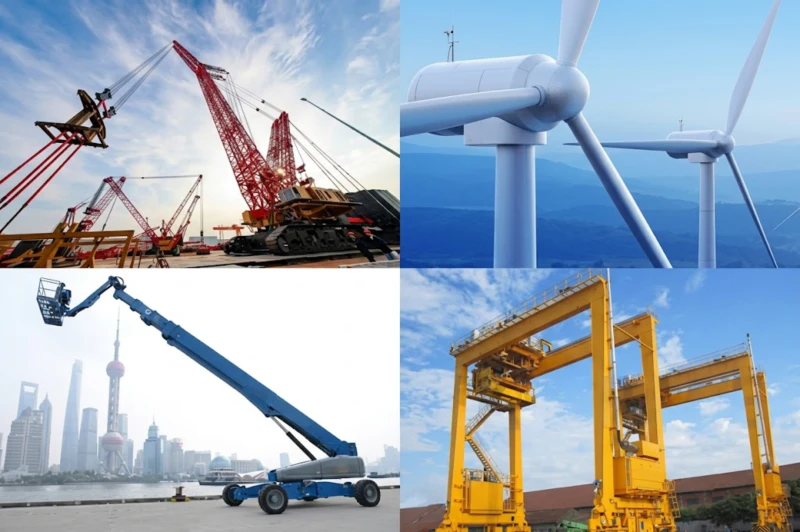
Robust slewing and hoisting transmission components are the hidden backbone of efficient maritime logistics.
5. Universal Dimensional Compatibility for Fleet Overhauls
Maritime maintenance scheduling requires rapid component sourcing to adhere to narrow dry-docking and overhaul windows. To support swift replacement protocols, our port crane transmission series are machined to mirror established global dimensional standards. From mounting flange diameters and bolt hole circles to exact pinion gear modules, our units integrate flawlessly into existing equipment frameworks.
Port engineers and MRO (Maintenance, Repair, and Operations) managers can confidently specify our units as direct drop-in replacements for major European component brands, entirely avoiding the need to cut, weld, or redesign the crane’s engine room structural plates.
| Crane Sub-System Application | Our Replacement Series | Compatible Industry Standard Footprints |
|---|---|---|
| Crane Slewing / Superstructure Rotation | SD-Drive Series | Rexroth GFB Series / Bonfiglioli 300 / Brevini S-Series |
| Main & Boom Hoist Winches | HW-Winch Series | Rexroth GFW Series / Zollern Hoist Drives |
| Gantry Travel / Wheel Drives | WD-Travel Series | Rexroth GFT Series / Comer Industries Tracks |
6. Integrated Assembly Solutions: The Planetary Motor
In traditional crane manufacturing, acquiring a standalone gearbox necessitates the subsequent engineering of bell housings, flexible couplings, and alignment plates to connect the designated electric or hydraulic motor. In the crowded machinery house of an STS or RTG crane, optimizing spatial efficiency is critical. To resolve these integration challenges, we offer fully unified Planetary Motor assemblies.
By bolting the motor directly to the primary stage flange of the gearbox during the factory assembly process, we ensure absolute shaft concentricity. This direct integration eliminates intermediate couplings, drastically shortening the total axial length of the powertrain. Factory mating also guarantees that the internal fail-safe braking mechanisms are perfectly calibrated to the specific torque curve of the attached motor, preventing load slip during emergency power outages.
For MRO teams, heavy equipment manufacturers, and procurement managers looking to wholesale Planetary Gearbox solutions for their maritime fleets, sourcing a complete, factory-tested integrated drive unit simplifies inventory management, accelerates the installation timeline on the dock, and provides unified single-source warranty coverage.
7. Practical Maritime Operation and Maintenance FAQ
1. How often should the gear oil be changed in port crane drives?
The initial break-in oil must be drained after the first 150 hours to clear manufacturing micro-particulates. Thereafter, high-quality synthetic gear oil should be changed every 1,500 to 2,000 hours, or annually, heavily guided by routine oil analysis programs.
2. What exactly does the C5-M marine coating protect against?
The C5-M (very high corrosivity, marine) standard utilizes a multi-layer epoxy and polyurethane paint system designed specifically to withstand constant condensation, high atmospheric salinity, and direct salt spray, preventing the cast iron housing from oxidizing.
3. How does the SAHR brake function during a port power failure?
SAHR (Spring-Applied, Hydraulically-Released) is a fail-safe design. Massive internal springs constantly clamp the brake discs. Hydraulic pressure from the crane is required to hold the brake open. If power fails and pressure drops, the springs instantly engage the brake, freezing the suspended container in place.
4. Why is low backlash critical for crane slewing drives?
Any mechanical “play” or backlash at the gearbox pinion is magnified exponentially at the end of a long crane boom. Low backlash ensures immediate, rigid stops, preventing the massive suspended load from swinging dangerously when rotation ceases.
5. Are these gearboxes rated for operations in sub-zero winter ports?
Yes, for ports experiencing severe freezing, we configure the units with specialized low-temperature Viton seals and mandate the use of low-viscosity synthetic oils to ensure proper lubrication flow and prevent seal cracking during cold starts.
6. Can the output pinion gear be customized to match an existing slewing ring?
Absolutely. We regularly machine custom integral pinion gears, matching the exact tooth count, module, and pressure angle required to mesh flawlessly with the crane’s existing turntable bearing.
7. What should be done if an oil sample shows high metallic content?
Elevated metallic particulates indicate active internal wear, likely from a failing bearing or gear tooth spalling. The unit should be scheduled for immediate removal and overhaul before catastrophic seizure occurs, which could drop a load.
8. Do port crane gear reducers require external cooling loops?
This depends on the duty cycle. For highly automated, continuous-use cranes (like ASCs) in high ambient temperatures, forced oil circulation and external cooling loops are often integrated to maintain safe thermal operating limits.
9. What is the typical manufacturing lead time for heavy marine units?
Standard footprint replacements are typically processed within 4 to 6 weeks. However, heavily customized units requiring specialized pinion machining or specific marine classification society certifications (ABS, DNV) may require 8 to 12 weeks.
10. How can port authorities arrange for fleet-wide replacement drives?
To secure volume engineering support, verify dimensional blueprints, or to order custom Planetary Gearbox assemblies for your terminal expansion or maintenance overhaul, please reach out directly to our maritime technical sales department.